

Donate
Every donation matters.
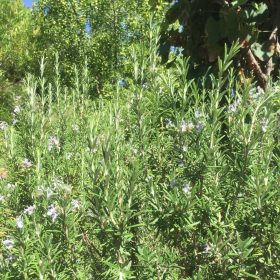
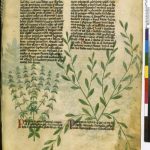
Scientific name: Rosmarinus officinalis (Lamiaceae)
Southern Europe to Western Asia.
Greek text: M. Wellmann (ed.), Pedanii Dioscuridis De materia medica libri quinque, 3 volumes. Berlin, 1907-1914, vol. 2, p. 88.
3.75. λιβανωτίς, ἣν Ῥωμαῖοι ῥουσμαρῖνον καλοῦσιν, ᾗ καὶ οἱ στεφανοπλόκοι χρῶνται· ῥάβδοι εἰσὶ λεπταί, περὶ ἃς τὰ φύλλα λεπτά, πυκνά, ἐπιμήκη [καὶ], ἰσχνά, ἔνδοθεν λευκά, ἐκ δὲ τῶν ἐκτὸς χλωρά, βαρύοσμα.
δύναμιν δὲ ἔχει θερμαντικήν, ἰκτέρου ἰατικήν, ἐάν τις αὐτὴν ἑψήσας ἐν ὕδατι δῷ πρὸ τῶν γυμνασίων πιεῖν, εἶτα γυμνάζων λούῃ καὶ οἴνῳ ποτίζῃ· μείγνυται δὲ καὶ ἀκόποις καὶ τῷ γλευκίνῳ χρίσματι.
English translation: based on LY Beck, Pedanius Dioscorides of Anazarbus, De materia medica. 3rd edition. Hildesheim, 2017, pp. 213,.
The rosemary which the Romans call rosmarinum and which wreath-makers use: it has slender shoots surrounded by leaves that are delicate, dense, somewhat long, thin, white on the inside, pale green on the outside, and oppressive in smell.
It has properties that warm and that cure jaundice, if one, after boiling it in water, gave it to drink prior to exercise, and after exercising, the person bathed and drank wine. It is also mixed with analgesics and with ointment of sweet new wine.
Disclaimer Text here..